Carnival Cruises emits ten times more sulphur oxide than all of Europe's cars (2019)
ecohustler.comThen IMO made some rules that there cannot be so much emissions (into air) and, as a consequence, the ships started using open loop seawater scrubbers which are essentially washing the exhaust gas and emitting all that same crap directly into the sea. Great benefit.
Cruses are pure luxury, we can do without them, it is seen as entertainment for the rich at the expense of everyone else, people usually don't take kindly of that.
Another difference is that cruse ships tend to end up in tourist places for everyone to see and smell, while container ships are in commercial ports, usually further away from where people tend to hang out.
You could get the exact same experience by booking a hotel at practically every tourist beach town you can think of.
> it is seen as entertainment for the rich at the expense of everyone else
There are other concentrations, such as around Turkey ( a major manufacturing country ) and then through the pinch-point of Gibraltar.
https://www.windy.com/-Menu/menu?cams,no2,9.998,64.187,4
It also gives and indication of where a lot of the global manufacturing is based!
Cars used by the poor to get to their jobs, on the other hand…
Increasingly the younger are going:
> Young travelers, especially those aged 21 to 39, are seeing those social media videos and responding with an eager curiosity for cruises. Cruise Lines International Association (CLIA) reports that Millennials (22%) and Gen Z (14%) now make up roughly 36% of all cruise passengers. Jason Liberty, president and CEO of Royal Caribbean Group, says about half of Royal Caribbean’s guests are now Millennials or younger (including those under age 20).
https://cruising.org/news/new-wave-cruisers-how-millennials-...
You know you're in a messed up state when 39 year olds are described as "Young travellers".
Many Millennials are over 40 too, lumping them in as "young travellers" and pretending it's an achievement to get 22% of your clientele from that demographic just demonstrates how aged the cruising demographic really is.
> rich people
I don't think you understand their target demographic
Cruises are more like the "affordable-living" option for the less-privileged who want to sail the sea. Sometimes just one time before they die.
Imagine saying something like this without realising the silliness of that statement.
Those who have cars and jobs and can afford to use the former to get to the latter aren't poor, by definition. Words have meaning, 'poor' means having little money and/or few possessions which tends to exclude those who have cars and jobs. Poor is not the same as 'lower class', 'not well to do', 'not affluent' or any such construct. Many countries have official 'poverty thresholds' which are closer to 'not well to do' than 'actual poverty', e.g. in the UK households are considered to be below the poverty line if their income is below 60% of the median household income after housing costs for that year [1]. That is not poverty, it is 'not well to do'. The international poverty line lies somewhere around $1.90 a day at 2011 international prices [2]. The former 'poverty' means those people can't afford to go on a foreign holiday, the latter often means they can't eat other than from garbage heaps.
Words have meaning.
[1] https://trustforlondon.org.uk/data/poverty-thresholds/
[2] https://www.who.int/data/nutrition/nlis/info/population-belo...
Context matters though. Here it is clear "poor" is in comparison to people going on cruises...
I think it is not silly for Americans. Minimum wage varies a lot by state and in some it a lot lower than the UK. Old cars are cheaper (because they do not need to meet standards like the MOT to stay on the road), petrol is cheaper and the need for a car is greater.
Words have meaning in various ways, most often related to the other words they are used with.
Also. there are plenty of people below the poverty line that own cars... perhaps not specifically using the standard of the international poverty line.
But, if you choose not to understand, you can find meaninglessness in anything I suppose.
Good day
It's not only rich people on these ships. In fact the richer the ship the more poor people are on it.
Positives: seeds cloud formation in the right way to cool, mitigating some of the effects of the greenhouse gasses.
https://en.wikipedia.org/wiki/Stratospheric_aerosol_injectio...
Is this data wrong?
dont ask me for the source please o_o i dont know anymore when i read that, was a couple years back
> The warming effect is consistent with the recent observed strong warming in 2023 and expected to make the 2020 s anomalously warm. The forcing is equivalent in magnitude to 80% of the measured increase in planetary heat uptake since 2020.
So S02 cloud seeding will produce cooling to a point... but eventually you hit a tipping point where the amount of trapped carbon released from the oceans overwhelms any cooling effect. It's also worth noting that the cooling effectiveness maxes out at 100% cloud cover, but that sulfuric acid concentrations in the ocean can continue to grow without a strict upper bound.
But climate change is already here, and already causing problems.
I don't know if this is metaphorically "trying to treat cancer with a medical plaster", or "a tourniquet to stop you bleeding out of the stump where your foot used to be": former in the sense of it's pointless, latter in the sense that leaving it on too long and doing nothing else will give you gangrene, but it also gives you long enough that you get a chance to worry about and fix such things.
1) non-toxic
2) biodegradable
3) have a very short half life in the atmosphere so if our models are wrong they won't hang around for centuries and start a new ice age
There isn't enough SO2 being emitted to meaningfully adjust pH of the oceans.
Mining is another heavy industry with a lot of regulations and people work around things like that, workers are just as unwilling and uncaring to fulfil regulatory requirements that make their lives harder. Unfathomable tonnes of waste get discarded wherever convenient underground, so long as the boss doesn't hear about it, he doesn't ask questions.
That's without having access to a vast ocean of international waters.
They go to minor lengths to avoid cabotage rules so seems reasonable they’d add other workarounds.
Yeah, but if the EU and US could agree to this, and also put it in their trade agreements, that's a pretty good start. It doesn't need to be solved everywhere.
“All passenger ships that sell berths for US citizens must comply with X or have their ships impounded/fines/taxes/etc.”
Get the EU on board as well and the problem is solved. They don’t have to patch every regulatory hole just make it more expensive than complying.
But it is illegal to port with low quality fuel and ships will be setup to run on multiple grades and use the less expensive grade allowed for where they are.
Ex. The Dali that hit the bridge awhile go in Baltimore had its “backup” system setup with the lower quality (and illegal to use in us waters) and it switched to that during it’s electrical issues.
I’m hardly an advocate for cruises (entire concept is disgusting and I think they’re a cholera time bomb…), but why is shuttling sneakers from around the planet more important than shuttling humans?
I generally side against those advocating for ‘freedoms’ when it ends up being a defence of shitty behaviour. However, I don’t love the idea of governments banning various types of business based on how ‘useful’ governments think the business is.
It's because the whole discussion is absurd. I can come up with a thousand things that are not important and detrimental to humanity. You just have a tiny problem of convincing hundreds of millions of people to give up their hobbies.
That is 0.48% of the population of the earth.
Can you give me 1 reason why cruises should not be shut down? I can do it for container shipping, important things are shipped that we need for modern society to function.
Talking about straw-man arguments.
If just 47 ships are more polluting by an order of magnitude than all the cars in Europe, I can only imagine how much is coming out of the container ships which I presume dwarf the number of cruise ships
Sulphur is a problem when there is a lot of it like in a city. It really isn't a problem otherwise. It really is a case of dilution is the solution for pollution.
What's sulphur dioxide going to do? Neutralize itself with calcium carbonate and fertilize the plants with an essential nutrient for protein.
No oil == no food
Extracting oil == bunker fuel
So, assuming you enjoy a veggie burger as much as the next guy, what should be done with bunker fuel?
Also, why is sulphur a problem?
I'd expect the 47 ships' CO2 output wouldn't be more than all cars in Europe.
Democratically-voted environmental policy has not found such wins to be "easy". The "rule of law" has lost every battle against the tourism industry and transnational petroleum.
Filtering sulphur is not trivial since it is a significant amount of the fuel. Where would the sulphur go? How does the filter not get clogged stopping the engine?
An argument could be made that bunker fuel should be banned in the Med and South China sea, due to the population centers nearby. But ban it all together? Its not obvious to be that wouldn't be worse (more oil extracted to make shipping diesel, energetically expensive cleaning of bunker fuel, etc).
Obviously cruises are dumb
https://www.cnbc.com/2019/07/15/oil-imo-2020-marks-the-bigge...
I’m exploring how to cleanly re-create those lost clouds over the ocean. Fuel additives, spraying sea salt into clouds, modifying ship routing. If this is up your alley hit reply.
but does anyone in this space take interest in public objection to (further, and continuously) altering the atmosphere and its balances/patterns?
Is this discussed? What is the community model on this - is it like fracking, where everybody tells each other there’s no way it’s big enough to make a difference to anything?
I don’t think this sulfur-in-shipping-fuels-creating-cloud-cover topic has been studied for decades, a lot of the research is new in just the last couple years
Carbon dioxide annual emissions, despite years of discussion around lowering them, continue to rise. With the resulting atmospheric levels reaching levels not seen in human existence. And this shipping fuel change is (surprisingly quickly) revealing some of the impacts of that, that the warming caused by carbon emissions is much higher than previously understood.
and other levers for environmental weather-pattern alteration (used both for vanity projects like the Olympics in China, all the way down to farming assistance and etc) that impact balances and threshold patterns in surrounding areas.
Damn, I knew the AWS CF format was tricky, didn't know they had advanced degrees in it! ;)
Somewhat counterintuively, if we suddenly somehow reduced our emissions to 0 overnight, the global warming would rapidly accelerate for a few years before declining.
edit: this data about cruise ships, handily omits the emmisions caused by billionare lifesyle, and rest of the 'liesure industry', and plonks respinsibility on people who are often enjoying a once in a lifetime post retirment adventure that is relentlessly promoted to them everywhere they look.
Regardless of the current strength of aerosol cooling, all future climate change scenarios project decreases in particulates and this includes the scenarios where 1.5 °C (2.7 °F) and 2 °C (3.6 °F) targets are met: their specific emission reduction targets assume the need to make up for lower dimming.[85] Since models estimate that the cooling caused by sulfates is largely equivalent to the warming caused by atmospheric methane (and since methane is a relatively short-lived greenhouse gas), it is believed that simultaneous reductions in both would effectively cancel each other out.[86] [87] Yet, in the recent years, methane concentrations had been increasing at rates exceeding their previous period of peak growth in the 1980s,[88][89] with wetland methane emissions driving much of the recent growth,[90][91] while air pollution is getting cleaned up aggressively.[92] These trends are some of the main reasons why 1.5 °C (2.7 °F) warming is now expected around 2030, as opposed to the mid-2010s estimates where it would not occur until 2040.[83]
the rest
https://en.wikipedia.org/w/index.php?title=Special:Search&se...
Agree the OP article is about SO, thanks for playing along.
I didn’t understand SO2 being zeroed out by methane. Like one warms, one cools, they cancel eachother out? In this case humanity is removing SO2 (net = warmer) and adding methane (net = warmer) so if seems they both make things worse.
https://www.scientificamerican.com/article/salt-spray-may-pr... (2013)
> There are many ways to try and climate engineer the planet, but many of them are so far-fetched that scientists aren't sure if they would even be physically possible, let alone physically successful. Sea-salt climate engineering (SSCE) might be the most low-tech, and plausible, possibility.
> In such a situation, specially designed unmanned boats would plow the seas, spraying salt water into the air. The water would evaporate and leave behind sea-salt particles, which may be lifted into the clouds, increasing their albedo, or reflecting power.
> A study released last month in the Journal of Geophysical Research: Atmospheres used three different models to run the same SSCE scenario in which sea-salt engineering was used in the low-latitude oceans to keep top-of-atmosphere radiative forcing at the 2020 level for 50 years and was then abruptly turned off for 20 years.
(If you want to read the study in full, https://agupubs.onlinelibrary.wiley.com/doi/full/10.1002/201... )
https://www.barrierreef.org/news/explainers/what-is-cloud-br...
https://atmos.uw.edu/faculty-and-research/marine-cloud-brigh...
> Atmospheric scientists are still not certain just how much of a cooling effect these aerosol particles have on the climate overall. Scientists estimate that aerosols from human emissions are offsetting 0.5℃ of global warming from greenhouse gases, but they could be cooling as little as 0.2 ℃ or as much as 1.0 ℃ (Forster et al., 2021). The uncertainty in this number leads to uncertainty about how much warming to expect in the coming decades.
> If the effect of aerosols on clouds is large, reducing aerosol pollution might significantly accelerate climate warming in the very near term. One recent paper concluded that there has already been an acceleration in global warming due to the decline in atmospheric aerosols since 2010, and projects that between now and 2040 the rate of warming may double due to this effect (Hansen et al., 2023). Recent steep reductions in particulate pollution emissions from ships that coincided with record ocean surface and global temperatures have increased interest in understanding and quantifying these effects.
It seems like those clouds _shouldn't_ exist if they are caused by sulfur being pumped into the atmosphere? Why do we want them back?
It would give us more time to address the issues before things go catastrophically wrong with the climate that we have.
If the argument is "we're not going to do anything anyways, might as well take our lumps with the new climate" then geo-engineering is a waste of time.
If the argument is "we need a bit more time to address the social and political issues that decarbonization brings about and get some sanity in the larger industrialized nations", then geo-engineering helps provide that time.
I'd predict that it would be used as an excuse to keep pumping fossil fuels for longer to increase that ppm since the urgency is dimished.
Sunlight does stuff besides create heat.
Are you aware of fungal infections and deaths spiking recently?
At the cost of whatever it is the sulfur in shipping fuel did that got it banned.
Don’t bog me down with non-conversation - you don’t like something I’ve said, tell us all why.
We're talking, strictly, about loss of the cloud cover over the oceans. Put that strawman away.
is the point I’m raising.
No straw man or speculation, just asking questions about known mechanisms of biology, ecology.
https://bpb-us-e1.wpmucdn.com/you.stonybrook.edu/dist/7/4538...
https://media.springernature.com/full/springer-static/image/...
https://www.frontiersin.org/api/ipx/w=1020&f=webp&v=5/https:...

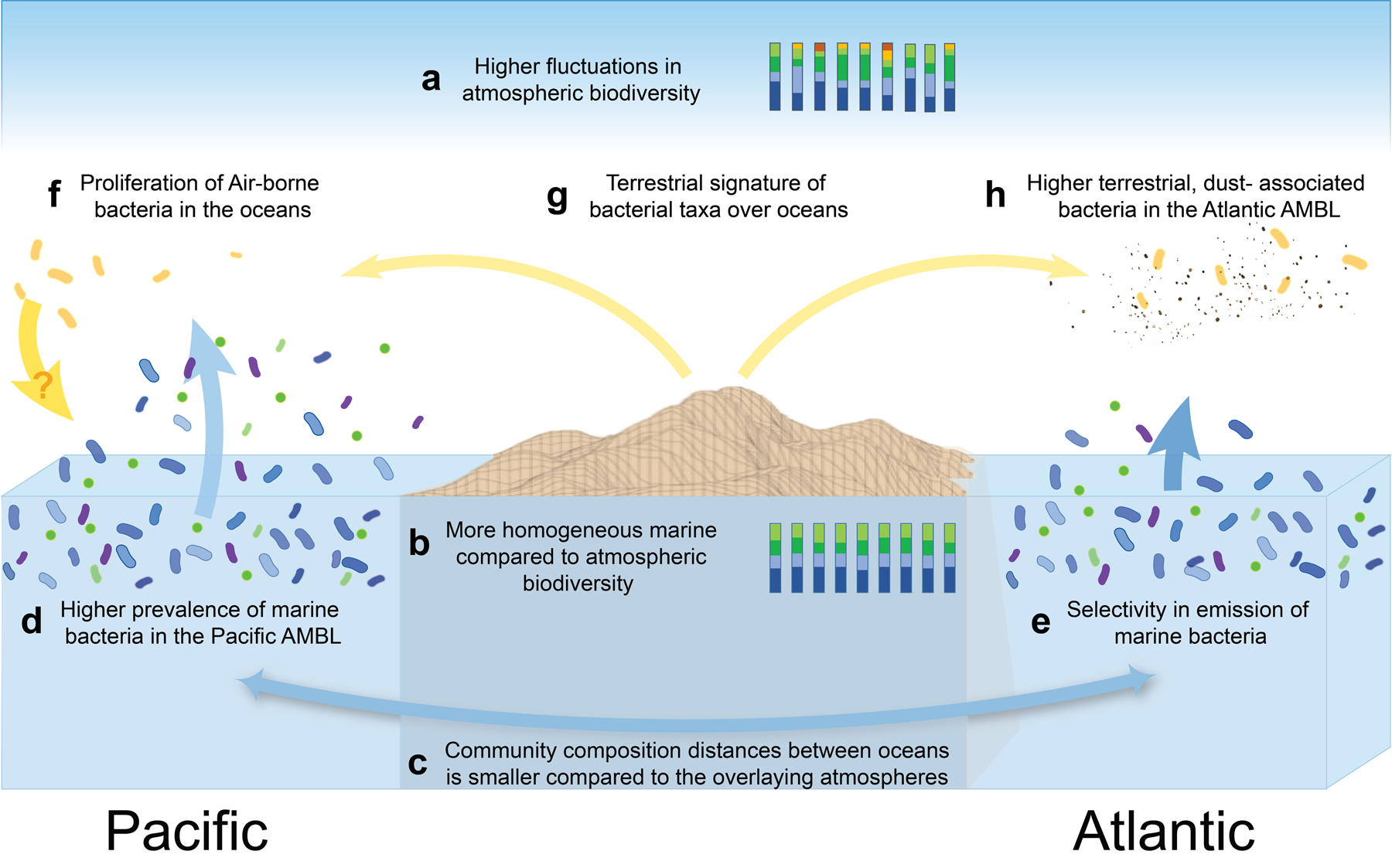
Only 25% of airborne microbes over the ocean are of marine origin, over 40% are terrestrial,
meaning the ocean’s air is our air; there’s a lot more going on out here besides the wellbeing of plankton and prawn (strawman).
No need to get snippy.
Happy for any followup questions.
Here’s an article from MIT explaining more: https://climate.mit.edu/ask-mit/how-much-global-warming-has-...
For lots of cargo, it doesn't matter if the shipment takes extra couple months.
We used to have a wind powered shipping industry before.
With solar/wind only, you would let the ship take longer. But it would be simpler and cheaper. Maybe a couple of batteries for electronics, but not for movement.
Going fully remote via Starlink would indeed be a requirement. You manage a bigger slower fleet instead of a single ship.
The first ship in the new wave is Neoliner Origin operating between Baltimore and France
https://en.wikipedia.org/wiki/Neoliner_Origin
Then this isn’t cargo but it is a very cool solar/wind electric ship for cruising the arctic:
https://selar.cc/pages/the-ship
A lot of the images are renders but the ship exists and going through sea trials now
They are both equipped with diesel engines as backup. Hopefully these two will provide valuable experience for these rigid sails.
Cornelis Drebbel (1572-1633) is my favorite Alchemist. Not only did he create the first cybernetic system (a thermostat) and perpetual motion machine (powered by fluctuations of barometric pressure) but also the first functional submarine.
Around 1620, witnesses saw it row under the Thames for hours.
Robert Boyle speculated how they might refresh the air — and of course oxygen is an issue — but carbon dioxide build up is bigger.
I suspect Drebbel used a slurry of lime as ballast to pull out the CO2. (I have a full sized replica of his sub in Amsterdam, but no I haven’t tried it yet.)
Just in case you wanted a historical perspective on carbon sequestration!
It just so happens that Beavers are the only other species capable of this kind of land use change.
So I think for this problem it’s us and the beavers…
Beavers are far from the only animal that produces land use change. But they are one of the smaller number that change it for their own benefit.
If reduction alone was an effective strategy we wouldn’t be where we are today.
What you're worried about is people looking for someone to blame ... and finding you. Politics, in other words.
Although I'll agree with politics on one front: any form of geoengineering, including further increasing global warming, will have winners and losers. And global warming is pretty unique in that it essentially only has winners. The earth becomes greener, more fertile, and needs a lot less heat. Fixing it will ... well, it will do the opposite.
But my mental model is that the stable climate we have is more like a light switch. It's not about a little warmer, it's about we go too far and switch into a chaotic climate unknown in the entirety of human existence. Even with the "big" affects we've seen so far, they're still in the "stable climate zone", haven't flipped the switch yet. Thoughts?
Doing nothing is certain doom, so why not do something? We can't fuck the planet any harder than we already have.
What do you mean doing nothing is certain doom?
Sorry, I mean to say that's the scientific consensus, in IPCC reports, ... Both of those.
Just cause the patient's hand is broken doesn't mean you should do something that risks losing the whole arm. At least not if you think about it rationally.
What on Earth are you on about?
Every other planet we know of is a counterexample to this argument.
The Earth is a paradise, but it's fragile; and things can get SO MUCH worse.
Here’s my two for why I say we’re still in a stable climate. But we are very much in a period where, if we don’t change anything, we won’t be for long.
1. If we look at the geological time of all of human existence, we’ve been around for 1.5° of warming before. And the climate didn’t fall off a cliff.
2. That’s said, Earth has not been at 420 parts per million of carbon dioxide in human history. We’ve never breathed air with this much carbon dioxide in it. If nothing changes over the next hundred years or so, then we will be in a chaotic climate unknown. (i’m not sure how strict a definition of this is, if nothing changes. If we continue emitting like we are, certainly, but if we halted all emissions today, which again I don’t think is all that likely, but it might be that we don’t go over the cliff)
The path ahead is clear. It’s up to us to figure out whether we change it or not.
To me, a chaotic climate is post ice shelves melting, poles going away, and tundra methane bomb going off.
Active measures to control (ie. choose) the outcome are known as geoengineering. Read up on it.
Wait, what? Are you seriously saying this?
One notable change to Bangladesh is that the southern desert has withdrawn ... literally to zero, there isn't a square centimeter of desert left, but it wasn't huge to begin with, plus it wasn't entirely in what is today Bangladesh.
In 1850, before global warming (or at least the human part), probably 40% of India was a desert, versus 13% now. And India is the size of Western Europe right. The area that became agricultural land and forest because of global warming is about the size of France PLUS the size of Germany.
Additionally, global warming is increasing the water available to Bangladesh, not decreasing it as you might expect. But as you point out, yes, there are winners and losers. Although, frankly, a water infrastructure project (that needs to be done regardless of global warming or not) could fix the lowlands problem AND help the water shortage in other parts of the country. That should be a priority, but they won't do it.
But yes, in summary, up to this point, I would consider the people of Bangladesh, and especially all of India overall winners in global warming. Very big winners in fact.
That won't stay that way: water shortages in the Ganges valley will get worse and worse over the next century (whether or not global warming continues, just for slightly different reasons in each case). And the economics of pumping water, sorry, means half to two thirds of those people have to leave. But the problem hasn't really taken off yet. It's a rounding error at the moment.
I do understand that past performance is no guarantee of future success and there are regions of India (not Bangladesh btw) that will become difficult to inhabit at over 2 degree warming. On the one hand I'd say they have plenty of warning, but I don't believe for one second they'll do anything about it.
The point is that change is change. Global warming has so far had very few victims (and yes "so far" is probably justified in that sentence). Really. But not zero. Absolutely. Not zero.
https://wsup.com/media-centre/news/what-bangladeshs-groundwa...
Among other considerable problems they caused they pumped so much water sea water is spreading inland through the ground and poisoning and contaminating the soil (apparently this doesn't just introduce salt, but also dangerous bacteria and viruses).
This is interesting in itself.
I wonder what this data looks like if you only took data from habitable places, e.g. you could grow grass naturally for a portion of the year.
Lots of nonsensical places to live are being propped up by cheap utilities right now…
The farms suffering from drought would like a word with you.
And yet we're still pumping up fossil fuels and this geoengineering would be used as an excuse to keep doing it. At some point we're going to feel other effects or potentially be trapped expending resources to keep the geoengineering going.
Looking at the cold, hard numbers, geoengineering isn‘t the best option to keep the nightmare level tipping points from happening. It’s the ONLY one.
This is a problem 200 years on the making and the numbers and the momentum is incomprehensible. We can scramble how many more teaspoons of rudder surface we can get into the water to turn the Titanic around, or we can use the same energy to put rubber on the hull.
All we need is buy us time for 50 more years, with something reversible in far shorter time, like a solar shield.
Any strategy which you fail to apply is going to be ineffective.
The reason I say that's the main problem, is because that's also the main problem with reducing fossil fuel usage.
It's fun to debate the technical details of geoengineering (solar shades, atmospheric aerosols, enhanced weathering, etc.), in the same way that it's fun to debate the technical details of carbon reduction (energy storage methods, approaches to electrical transmission, remote work, land use, etc.).
But none of that really matters if we, collectively, don't actually do anything! It's not as fun as comparing scifi fantasies, but the problem we need to solve is that of getting humanity to actually do something, at scale, which is collectively acknowledged as necessary yet is not immediately/individually profitable.
If we could solve that, then we could do geoengineering; but in such a world, we might not need to, because we could also do carbon reduction, plus a bunch of other stuff!
However, if we can't solve that, then geoengineering is an illusion.
It's a grass-is-greener fallacy: what makes any geoengineering project seem remotely feasible, in a world where we can't even coordinate on the obviously-a-good-idea stuff?
Why change the habit of a species? Just saying.
Clutching at our pearls at this stage just seems a bit ... ridiculous considering what's gone on.
As opposed to trying to flinch away from it and pretend it doesn't exist. And then acting surprised when that doesn't make their influence go away - and merely makes it unguided, purposeless and often harmful.
The way I see it, if we want to inhabit this planet for the next several hundred thousand years, eventually natural variations will arrive that swamp anything we've done in our usual passive, uncoordinated fashion. So if we want to keep living here, we're going to need to figure out how to set the world's thermostat. Might as well start working the problem now.
Geoengineering on a planetary scale is like "fixing a bug" in a foundational software service without enumerating all the customer use cases - you will get burned.
As an example of the system's complexity that blows my mind, scientists discovered that bears pulling salmon out of rivers is a critical supplier of nitrogen to the forests on the west coast.
Feels more like saying “we’ve been smashing the house up by flailing this hammer around wildly, and now you suddenly want to use it to repair the furniture?!” Sure, I get the temptation to lick the hammer away in a box, and the carpenter will eventually repair the house without a hammer, but I think they might be faster with the hammer.
The real danger of geoengineering (and perhaps a good reason to hold back until we’re well on the path to carbon neutrality) is that it can hide the long term damage in the short term, and we need people to reduce the long term damage, or geoengineering becomes a crutch.
Or to bring my metaphor back, we really don’t want to our carpenter to start seeing everything as a nail just because they’re holding a hammer.
Yes, that's geoengineering; but it's not "collectively acknowledged as necessary yet is not immediately/individually profitable". That was a crucial part of my argument.
It's not hard to drive adoption of things which are profitable (quite the opposite, e.g. we have all sorts of black markets).
> Clutching at our pearls at this stage just seems a bit ... ridiculous considering what's gone on
I wasn't pearl clutching. I was pointing out that beneficial, climate-mitigating geoengineering (which, unfortunately, is not directly profitable) is not actually happening. Like, at all.
Complaints about carbon reduction not happening fast enough are absolutely valid; but that also undermines any hope of doing enough geoengineering either, given that's even less active, and has even less incentive (it wouldn't be a full solution, potential downsides, yada yada). Again, I'm not saying we shouldn't do it because of those factors; I'm saying that it's literally not happening, and those factors don't help with adoption.
Conversely, if we try to hand-wave the coordination problem for (beneficial, not-directly-profitable) geoen, and just assume that enough powerful actors will eventually get on board with geoengineering for whatever reason; then why can't we wave our hands in the same way for carbon reduction too?
I'm not complaining about the implementation details, I'm complaining about the logic. It's a grass-is-always-greener fallacy: geoengineering would suffer exactly the same coordination problems that are clearly hampering the carbon reduction approach. Unless we solve the coordination problem, we can't do either of them.
Geoengineering can be carried out by a single country unilaterally. That's the geoengineering edge.
Emissions have to be solved by every major country, and in coordination - otherwise, economics favor whoever neglects to do it. That's a coordination task orders of magnitude more severe. If your argument against geoengineering is "coordination", then you should be forsaking "emission reduction driven by political action" ten times over. Same goes for "carbon capture at scale."
The only tool that leaves you with is "emission reduction driven by economic forces." Which may well be sufficient. But I'd rather not leave tools on the table.
This has plusses and minuses, but mostly minuses. It is less invasive to the rest of the world's ecosystems than either continued global warming or solar geoengineering with sulfur compounds. Most of the damage is confined to humanity, along with making a few areas that were already ecological wastelands uninhabitable (though interestingly, that has improved biodiversity in the Chernobyl Exclusion Area and North Korean DMZ). The downside is, of course, that 75-90% of us will be dead and whatever modern technologically-advanced society we have will collapse.
The MAD nuclear standoff means that every country stands to lose a lot and gain very little by pulling the trigger. If starting a nuclear war is lose-lose for every actor, war can be prevented with low coordination burden, as long as the decision-making remains anywhere near "rational self-interest."
1) There are not so many nuclear-armed states that one country can launch an attack and have enough country blamed for it. Likewise, there are not so many nuclear-armed states that one country might launch nukes by accident or irrationality.
2) All nuclear armed states have a future, i.e. there is no nuclear-armed power that is facing an existential threat other than nuclear weapons.
#1 is the wisdom behind nuclear non-proliferation, and why all nuclear-armed powers do everything they can to prevent other states or non-state actors (like terrorist groups) from getting nuclear weapons. If there is ever a situation where a suitcase nuke goes off in Washington or Moscow and they aren't sure who did it, the world ends. The set of nuclear-armed powers initially started with the 5 members of the UN Permanent Security Counsel and since then has expanded by Israel, India, Pakistan, and North Korea, with Iran being widely suspected of being close. You see similar examples of cartel-collapse (another MAD situation, with lower stakes) when the number of participants reaches about 10 - notably, one mechanism by which OPEC prices often collapse is when smaller member states secretly overproduce and Saudi Arabia has to cut to make up the difference. Another mechanism is when new firms enter the market without any incentive to maintain the existing detente (eg. the U.S. entering the oil market with the fracking boom of the early 2010s, or Facebook blowing up the high tech wage-fixing cartel by poaching everybody's employees with generous stock grants).
#2 follows from the finite/infinite game distinction. As long as the payoff for launching nukes is destruction of your state, there's a strong incentive not to do it. But if your state is gone anyway, and launching a war of aggression gives you a chance of not dying, the incentives flip. A (non-nuclear, but business) example of this was the patent detente among major tech companies in 2010, "and then Nokia launched the missiles". They were facing bankruptcy anyway, launching a bunch of patent troll lawsuits gave them a potential way out, and if everybody else retaliated, the worst that would happen is they go bankrupt, which was happening anyway.
I've heard a number of geopolitical analysts speculate that the Russia/Ukraine war was driven by exactly this: Russia's terrible demographics following the post-Soviet collapse, compounded by the death toll from COVID, meant that they will no longer have the capacity to wage war as an advanced industrialized power within 5-10 years, and so it was now or never. Climate change is another very obvious trigger for why a state may end up default-dead and hence have nothing to lose from starting WW3.
Exactly! We must learn to cope with it. Without stopping to look for a solution that does not impact the economy negatively.
Inaction is, on the other hand, very easy to justify. That doesn't make it a good choice.
Acting now with imperfect understanding beats letting climate change unfold as is.
"Stop pumping out crazy amounts of CO2" sounds nice on paper, but has proven challenging to implement in practice - fossil fuels are too damn useful. And even if we got over that hurdle and somehow terminated CO2 emissions to net zero by 2030 (fairy tale levels of realistic), we'd still have decades of warming baked in because of CO2 that was already released.
In reality, it seems likely that the burn on fossil fuels will continue for as long as it makes economic sense for it to. Read: multiple decades before net zero at the minimum.
So, are we going to eat multiple decades worth of global warming - or are we actually going to do something about it?
Because geoengineering has already mapped out levers with outsized effects on climate. And we understand pretty damn well what the consequences of not pulling those levers are.
(disclaimer that I manage a climate research group, and this hit a nerve because we've had balanced discussions on this topic ad nauseam for the last 30+ years)
And as soon as a major country experiences a climate event (especially heat wave) which seriously endangers its ruling class, the gloves are going to come off - "Shut up and seed those big, reflective clouds NOW."
The earth seems to get along just fine without us and it keeps showing us by somehow always being the last thing standing when yet another civilisation collapses - as ours will too.
Somebody wants to try remediation, and instantly folks say Whoa! Not so fast!
Or do you mean it's better to do unintentionally?
https://attheu.utah.edu/research/cleaner-ship-fuel-changed-c...
Not even clear if there was a change ...
> It turned out that the clouds after the fuel change held more total water overall, which balanced out changes in droplet size and maintained cloud solar reflectivity, known as albedo. Had the albedo of Atlantic clouds reduced, they would have reflected less of the sun’s heat back into space, thereby warming the climate.
>In 2020, fuel regulations abruptly reduced the emission of sulfur dioxide from international shipping by about 80% and created an inadvertent geoengineering termination shock with global impact. (...) The amount of radiative forcing could lead to a doubling (or more) of the warming rate in the 2020s. (...) The warming effect is consistent with the recent observed strong warming in 2023 and expected to make the 2020s anomalously warm.
But haven't we recently learned that marine algae are the primary net absorbers of CO2? cutting their sunlight therefore cannot do much good. Better than we cut sunlight over land than water. (Plants absorb CO2 but do not sequester it nearly as much as oceanic algae.)
https://www.whoi.edu/ocean-learning-hub/ocean-topics/climate...
https://en.wikipedia.org/wiki/Iron_fertilization
It's based on that the bottleneck for marine algae is nutrients... and so if you dump a few tons of rust in the ocean, you'll fertilize it, start an algae bloom which absorbs CO2 out of the water (allowing it to be replaced by atmospheric CO2)... and then when the algae dies it descends to the ocean floor where its trapped.
https://cpo.noaa.gov/the-unintended-consequences-of-reducing...
Climate science is complicated and confusing.
Seriously? How much "other pollution" do "all of Europe's cars" emit, besides the sulphur oxide?
https://www.abports.co.uk/news-and-media/latest-news/2022/sh...
https://www.imo.org/en/mediacentre/hottopics/pages/sulphur-2...
What gets shipped in around 2-3 years and what’s being done in research looks very promising
Spain, for comparison, took over 20 years to get their coal use down from ~40% but they had much worse renewable options back then and needed to rely on gas a lot.
Much faster than that. Even worldwide, the trend on each of those by itself puts PV above 100% of all current global electricity supply by the early 2030s and wind by the end of the 2030s.
Combined, and considering what hydro and nuclear already exists, we could easily anticipate that on top of covering all electrical demand, in ten years everything has been electrified.
But an important thing to consider is that coal in China also completely fills the typical role of gas for electrical generation (=> dispatchable source). For a somewhat fair comparison it's thus sensible to group coal+gas, and you'll find plenty of wealthy western countries that are similarly overreliant on fossils in that metric (yes gas is less harmful, but nations don't get to pick which fossils are available to them).
But despite this, China is pretty close to EU per capita emission and significantly lower than the US. Cumulative emissions are also much lower than either, despite representing a larger population than both of those combined.
Carnival Cruises emits ten times more sulphur oxide than all of Europe’s cars - https://news.ycombinator.com/item?id=20203006 - June 2019 (158 comments)
I definitely think that cruises are probably up there in the top ten, if not the top five, of the most wasteful recreational activities available to most people on Earth.
I have some friends who regularly go on cruises and I always just wonder: why not just go to the beach? It's basically the exact same thing, or book out a hotel that's close to the beach. Hell half of Miami basically recreates everything a cruise ship has but on land.
Also, if golf courses were converted into sports fields, would you feel similar?
My big problem with golf courses are the huge amount of area required for something which is relatively niche. Even sports I don't particularly like, such as baseball or football are much, much more popular and have tons of spectators, which makes their land use feel a bit more valuable. The other problem would be water usage and herbicide usage. All that water and herbicide just so a tiny portion of the population can play golf more easily. Feels like a total waste.
I had a friend who is a fan of cruise ships call Carnival the "Section 8 cruise ship."
This wasn’t worth digging up from 6 years ago.
If humanity agreed to stop all cruise ships we would safe more pollution then any other measure we are forced to make currently (which could still be done in addition). To me the fact that cruise ships are still operating proves that most governments are not interested in actually improving climate pollution.
To me it seems like the lowest hanging fruit in the climate disaster.
If not, where are you drawing the fine lines?
A critic could allege that the claim is really "all things not strictly required for life that I don't value or appreciate that consume resources are immoral".
I'm not aware of the details of this, what are the actual costs of sulfur oxide in the air?
And as always with utilitarian arguments, why is your evaluation function special?
If we were to just accept that "sulfur oxide is bad", then why wouldn't the obvious answer be "ban burning high sulfur gas", not "ban cruises"?
I like cars, we ban cars from the road that pollute too much. I like racing cars, still it is illegal to race on the public road because it would be unsafe. Why shouldn't we extend the same thinking to cruise ships? Especially regarding they only provide entertainment with a clear alternative, go to a all inclusive hotel.
Let's not pretend like banning cruise ships will lead to banning "all things not strictly required for life" like going for a walk.
The cruise thing is an irrelevant detail.
"Let's not pretend like banning cruise ships will lead to banning "all things not strictly required for life" like going for a walk."
If that's not what you're saying then you need to explain how the analysis is wrong and what's so special about crusises morally.
Lead bullets directly put lead in the environment, something we want to prohibit. Fireworks directly cause fires, something we want to prohibit.
Cruises don't directly cause pollution. If we want to cut down on sulphur emissions, we can directly ban that, and let the cruise industry adapt.
Banning the activity stinks of "my hobbies are better than your hobbies". Cruises are not my cup of tea either, but it's not my place to judge how other people want to experience leisure. Just wait until you hear about all the gasoline I "waste" on frivolous motorcycle adventures.
> If your problem is polluting, shouldn't you ban polluting then?
Why don't you explain what's so special about cruises morally that we should keep them even though they are huge polluters and riddled with other problems?
Because even though there is a clear alternative (go to a hotel). Why Do you need to be on a hotel on the sea with 6500 other passengers so bad that it warrants destroying the planet?
I do however additionally think that we should have far stricter regulations regarding what can be shipped by sea because of pollution, for example the global bottled water industry.
https://www.theguardian.com/sustainable-business/2015/jul/09...
At least some very rich people get a kick out of it. Here's a better one: the entire EU parliament has to move to Strasbourg and then back to Brussels monthly.[0] The MEPs don't like it, it costs a bunch and burns a lot of avgas, and the official rationale for mandating this madness is that "that's how we've always done it."[1]
None of this is to say that cruises should continue to be allowed, but some fruit is practically touching the ground by this point.
[0]: https://www.politico.eu/article/france-cancelling-european-p...
[1]: https://www.europarl.europa.eu/news/en/faq/3/why-does-parlia...
The fact that WFH is not being strongly encouraged, or even mandated where possible, is what convinced me governments aren't serious. There was an excuse before 2020, there isn't now.
I also don't see why meatball subs are still allowed, the bread gets soggy, ground beef is bad for you and the environment. And they taste bad.
However perhaps you are not familiar with the amount of pollution a cruise ship generates. Cruise ships are on such a different scale, therefore they should be considered a lot more seriously compared to your local sports event.
We also allow fireworks for entertainment but not nuclear bombs.
Its mind boggling how many narrow minded people we have in allegedly developed society. I don't like it so lets ban it! Because of "climate crisis" (or whatever BS they come up with to justify the fascism)
This isnt me defending cruises, just pointing out an awful argument.
However, now that we just have EVs and are no longer desensitized to car exhaust, I cannot imagine spending a week near the smoke stacks on a cruise ship. Maybe they should look into doing something that's sail-assisted + battery powered, or something.
On the other hand, I have no desire to go on a cruise, so they probably won't get my business either way.
Perhaps we should also be thinking about non-human cruise ships or do they magically pollute less because they transport the worlds future burgers?
* https://www.imo.org/en/mediacentre/hottopics/pages/sulphur-2...
* https://www.cmacgm-group.com/en/low-sulphur-imo-2020-regulat...
Is this particular issue (sulphur) still an issue?
If I say cars in (pick up any EU country) pollute way more than car in any sizeable province in China. This will likely be true, but people won't like it, isn't it
Maybe it is a hit piece on Carnival? Because the entire cruise industry emits a whopping 0.8% of the sulphur dioxide that the shipping industry itself does [0].
[0] Fourth International Maritime Organization Greenhouse Gas Study 2020, page 11 figure 9, https://wwwcdn.imo.org/localresources/en/OurWork/Environment...
Like any medicine, quantity and location matter. Here's what would happen if we pump quantity so2 saved by cleaner maritime fuel into the stratosphere: https://makesunsets.com/blogs/news/move-smoke-to-cool-earth
https://www.pressreleasepoint.com/reactive-statement-transpo...